A platform shaped by data, not politics
Travelers had a vision for their digital transformation but hadn't done user research in nearly a decade. Updates to the legacy intranet had been handled on an ad hoc basis for years, and three stakeholder groups — technology, communications, and HR — were aligned on wanting a better platform but divided on what that actually meant. Without grounded data, the project was going to be shaped by internal priorities rather than what employees actually needed.
My research reframed the problem and gave the team a common language to build from. That research grounded every decision that followed: stakeholder alignment, vendor selection, design governance, and a beta study ahead of launch. The team successfully launched the platform, confident they had prioritized employee needs and equipped with a five-year roadmap to deliver better experiences.
A labor of love with real limitations
The Travelers legacy intranet was a labor of love. The marketing and tech teams had spent more than a decade building it out, but they were equally aware of its limitations. Users had long struggled to find information, and the shift to remote work during the pandemic demanded more functionality than the platform could deliver. Site updates had been reactive — driven by one-off user requests over the years — and no formal user research had been conducted since 2016. The digital transformation project was their opportunity to change that.
The initial ask was focused on improving search and integrating HR content into a single hub for employees — both real user pain points. But with limited understanding of the holistic user experience and three stakeholder groups who agreed on wanting a better platform yet disagreed on what that actually meant, the project was beginning to take shape around internal priorities rather than what employees truly needed. The more research I did, the clearer it became that improving search and integrating HR content were symptoms of a larger, more systemic problem: a disconnected employee experience.
Understanding the problem before solving it
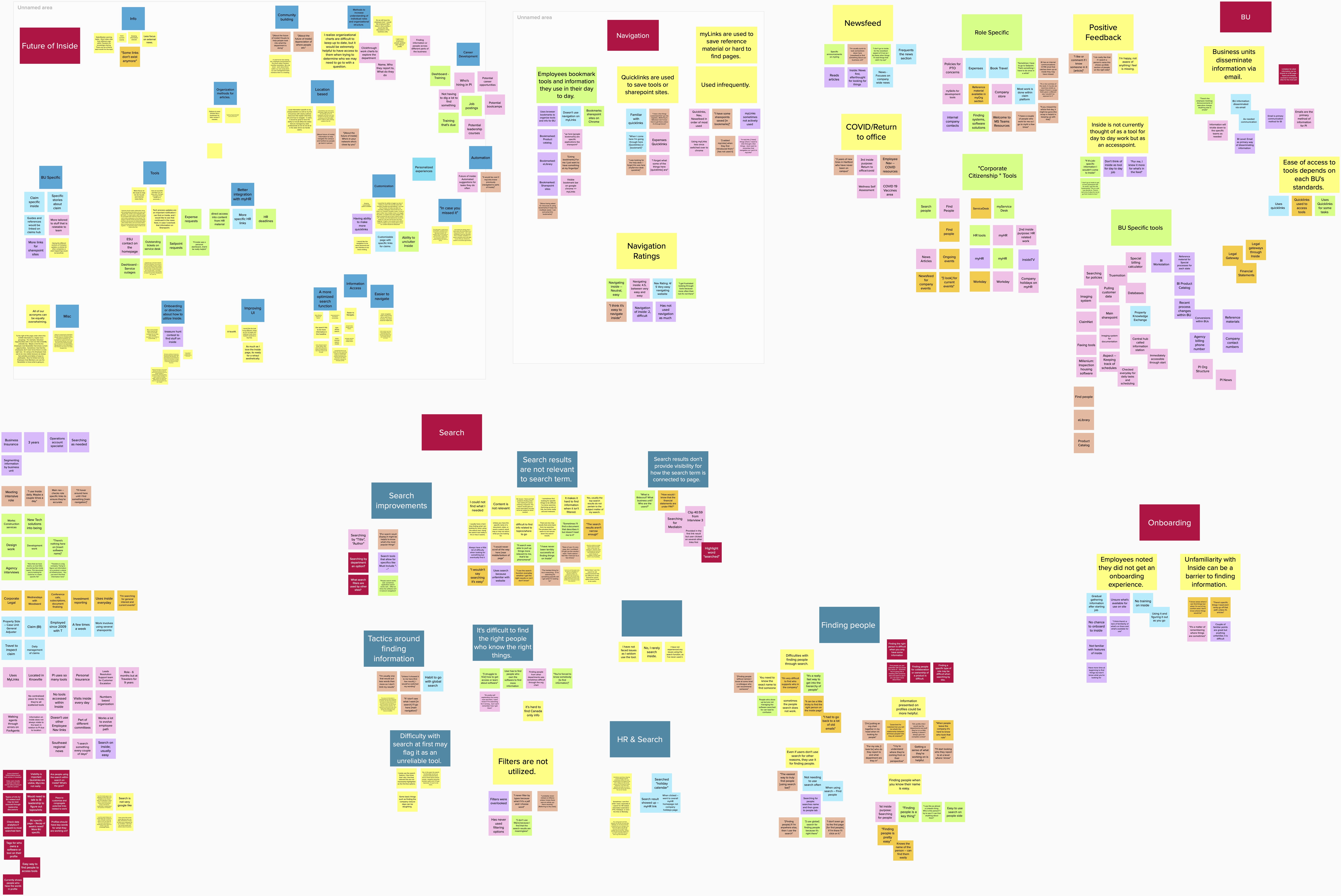
I explored secondary research, reviewed data analytics, conducted user interviews, and sent out a survey to understand how employees used the intranet in their day-to-day, what was frustrating them, and what they wished it could do.
We learned that the team was on the right track, wanting to improve search first. To employees, the intranet was about finding information quickly and organizing their work. In an organization of 40,000 employees and 15,000 contractors, finding the right person was just as hard as finding the right document and they often went to the intranet first to find someone. Employees also relied on elaborate personal systems to save information and greatly appreciated customization like bookmarks and quicklinks because the navigation was often difficult to use.
Our discovery research highlighted there was low-hanging fruit we could act on quickly that could improve the user experience on day 1. More complete profile areas, improved search, better navigation and opportunities for customization were all within reach if prioritized properly.
Throughout my research process, I shared my findings incrementally to bring stakeholders along rather than presenting everything at once as a finished product. Small touchpoints throughout kept the team familiar with what we were learning and why it mattered.
Three groups, one vision
After the initial discovery research was complete, we had a better understanding of what users needed, but how we got there and when was unclear.
Our primary stakeholders came from technology, communications, and HR, all with different goals and different frustrations with the current platform. Technology wanted something future-facing and bold. Communications didn't want to lose editorial control or make too many changes that would frustrate users. HR was focused on security. It became clear pretty quickly that we'd have to take time to align on a singular vision before any of it could move forward.
This is where intentional collaboration mattered most.
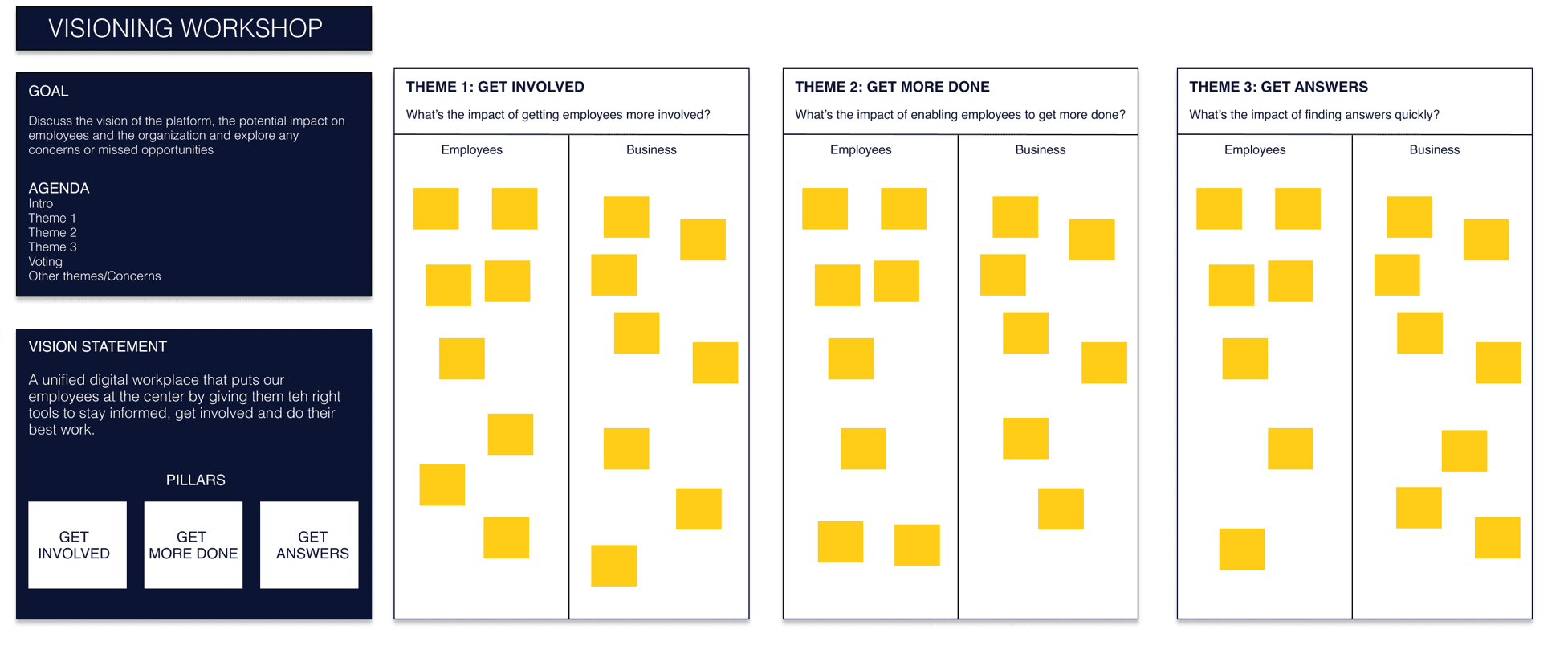
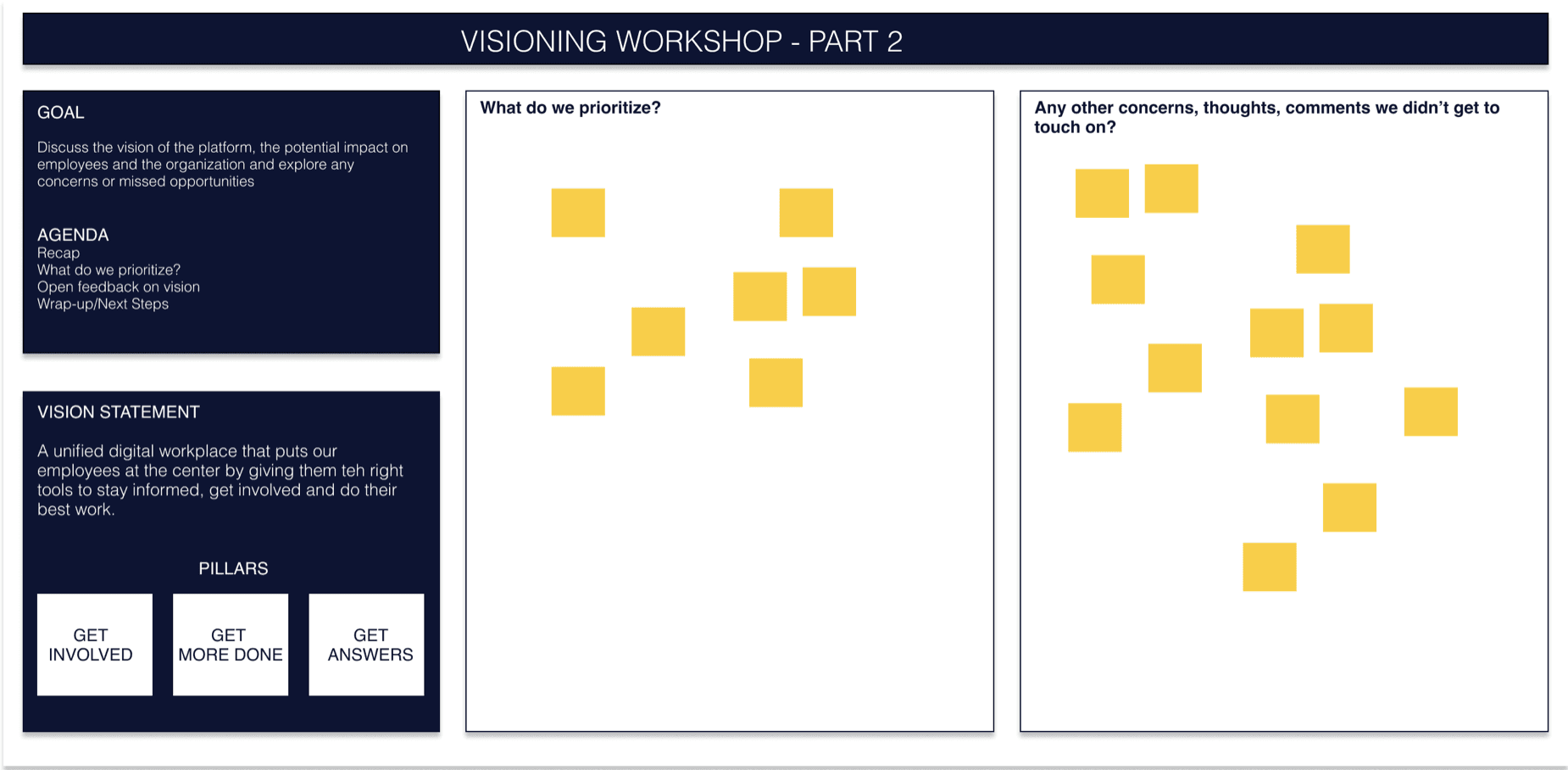
To further define our alignment, I conducted a visioning workshop that brought our leaders and team together to discuss our vision statement and our three pillars to support employees in getting involved, getting more done, and getting the answers they need.
Our discussions surfaced opportunities and risks for both employees and the business across these three pillars. As we worked through each section, it quickly became clear which areas mattered most and, in turn, which features would best support those priorities.
A synthesis of this workshop and previous research helped our product team develop a five-year roadmap that balanced the low-hanging fruit that would deliver business value for the teams while making the employee experience better with future-facing initiatives.
Evaluating vendors without letting politics decide
With our vision and priorities aligned, we moved to the vendor evaluation phase. To assess our three POC vendors, I built a scoring framework across three dimensions: features, end-user experience, and content authoring experience. Evaluator responses were anonymized to keep organizational bias out of it. The evaluation used three approaches: a Single Ease Question scale across 14 core functionalities, a System Usability Scale for overall comparison, and open-ended responses to capture how people felt about each vendor’s experience. Our participants were our developers, content authors, and HR personnel as well as 50 participants across the business who were representative of their discipline.
What made the findings particularly compelling was how closely they mirrored what we had uncovered during discovery. Employees had told us the intranet needed to help them find information fast, locate the right people without having to ask around, and feel tailored to how they actually worked. The vendor that rose to the top was the one that prioritized exactly that: strong search, accessible profile information, and meaningful customization. This held true across both the content authoring and end user evaluations, making the recommendation straightforward to stand behind.
It gave executive leadership and our team the data they needed to get behind the decision with confidence.
Building for 300 authors at scale
While I worked closely with the vendor to design and test key areas of the site, including profiles, community hubs, and the homepage, a significant amount of content still needed to be migrated from the legacy site.
Launching the platform meant migrating over 2,000 pieces of content, 3,000 articles, and 11,000 documents, all done by four content authors. The platform would then be maintained by 300 decentralized business contributors, most without a design background.
I evaluated 100 existing pages to understand what templates were in use, usability concerns, which components were common, and where variation across business units lived. I quickly learned it was the wild west in some business units. A unified site experience would require guardrails and templates to support content others.
That analysis led to three core templates: an aggregator page, a landing page, and a static content page. We tested them with content authors in three working sessions, giving them real tasks to complete in the new templates.
From there, I built a governance site within the platform, documentation, examples, dos and don'ts, and widgets pre-styled to the design system. The goal was to give authors a starting point that made consistency easier to achieve, especially for someone being onboarded quickly into a large, decentralized team.
Validating before go-live
Before go-live, we ran an unmoderated beta study with employees from different business units and disciplines covering navigation, search, profiles, and core tasks. The findings validated that the major decisions held up and gave us a final round of adjustments before launch.
The platform launched with all content migrated over with improvements focused on search, profile and customized modules for users to leverage on day one with many more to come over the course of the next 5 years.